
Made For Each other: Ishpeming vs. Loyola
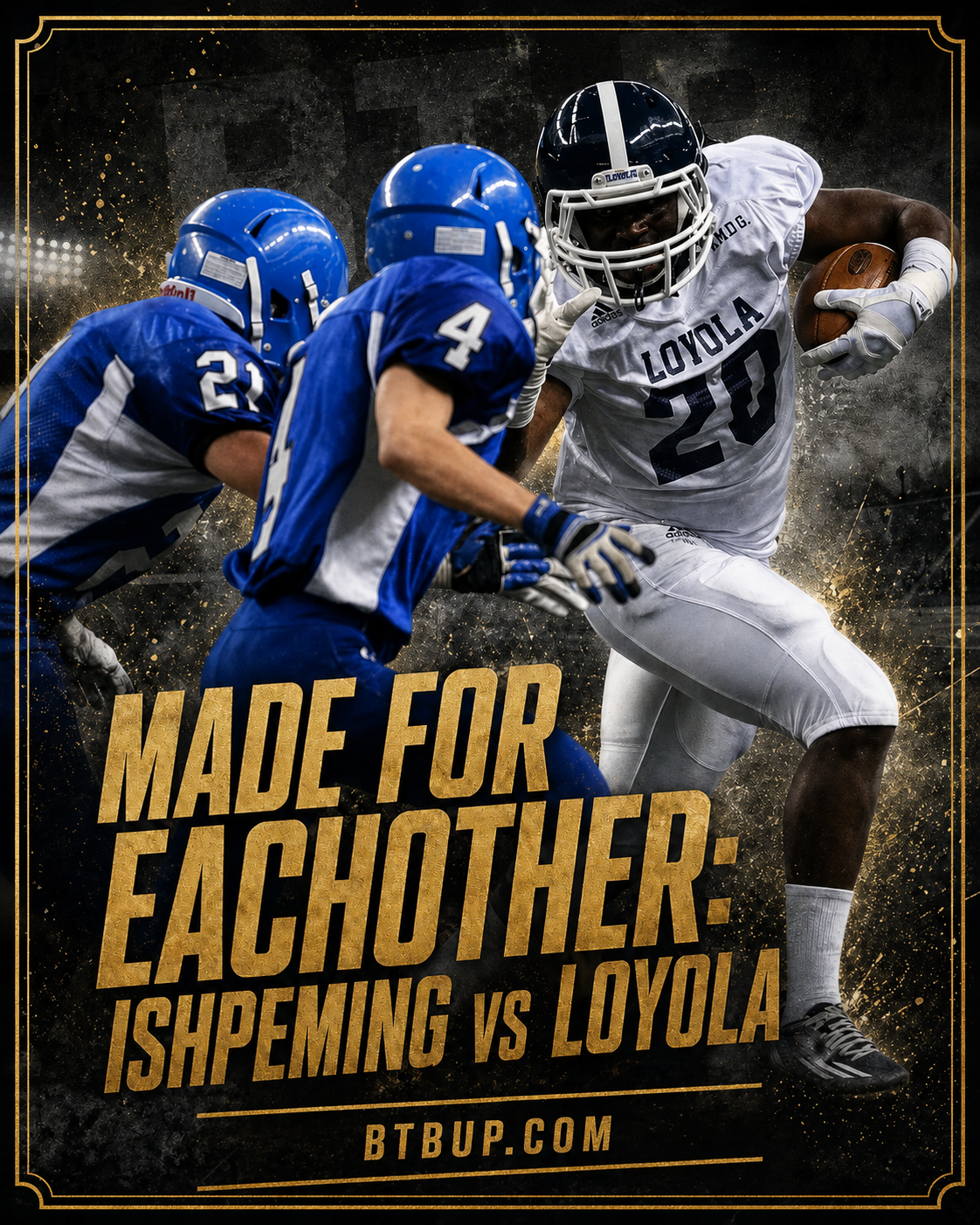
Two teams nearly 500 miles apart found eachother for three straight seasons, and the story is deeper than David vs. Goliath
Loyola and Ishpeming High Schools are 466 miles apart. In culture, geography, and lived experience, they may have existed on different planets.
Detroit? Steel, smoke, soul music, corner churches, and generations of people taught to fight for a city the rest of the country kept trying to bury. Eventually, the attitude became a rallying cry: Detroit vs. Everybody.
Ishpeming? Miners, nurses, teachers, bitter winters, and a kind of stubborn pride that tends to grow in places the rest of the state forgets about. A town where everybody knows each other, where Friday nights still matter, and where high school sports feel stitched into the identity of the community itself.
History had not found many reasons to bring them together. But for three years, football did.
For more than 50 seasons of Michigan high school football, only twice have the same two teams met in three consecutive state championship games. One was Crystal Falls Forest Park and Flint Holy Rosary from 1975 to 1977. The other was Ishpeming and Detroit Loyola from 2012 to 2014.
Upper Peninsula and Lower Peninsula teams have crossed paths several times in state championship games, sometimes more than once. Usually, it becomes little more than a footnote in history — a trivia question about which U.P. team once played a school from below the bridge.
Ishpeming and Loyola were different.
By August of 2012, Ishpeming had already lived through an entire season's worth of emotion before taking a single snap.
About a month before the season in late July, Hematites head coach Jeff Olson suffered an unimaginable loss when his son, Daniel, died by suicide. Weeks later, Ishpeming kicker Eric Dompierre — a student-athlete with Down syndrome — was nearing the end of a two-and-a-half-year legal battle with the Michigan High School Athletic Association over his eligibility to play at age 19. The case drew national attention from ESPN, CBS, and other major outlets. Eventually, Dompierre won.
Olson chose to return to the sideline that fall, believing part of the healing process meant being around his team again. Dompierre, after years of uncertainty, could finally focus on being what he had fought so hard to become: a student-athlete.
Before Ishpeming ever reached Ford Field, the Hematites were already carrying something heavier than football — grief, uncertainty, and two very different forms of perseverance that shaped the season long before the games did.
The Hematites finished the regular season 8-1, their only loss coming against rival Negaunee. Once the playoffs arrived, they continued to survive. Lake City pushed them. Pewamo-Westphalia nearly stopped them. But Ishpeming kept advancing, returning to the state championship game two years after a heartbreaking loss to Hudson — a year where Olson's late son, Daniel, was the quarterback.
Waiting for them at Ford Field was a team that, on paper, looked like it belonged in another division entirely.
Detroit Loyola was massive, fast, and loaded with future college talent.
Offensive lineman Ka'John Armstrong stood 6-foot-5 and weighed 300 pounds, eventually spending time on the practice squad with 3 different NFL teams after a successful college career at Eastern Michigan.
Defensive end Malik McDowell was a 6-foot-6, 300-pound five-star recruit who later starred at Michigan State before becoming the 35th pick in the 2017 NFL draft by the Seattle Seahawks.
Running back Keymonne Gabriel averaged 11 yards every time he touched the football.
Entering the state final, Loyola had outscored its playoff opponents 172-27. Most expected a running clock, but instead it was the Hematites who ran.
Ishpeming won 20-14, pulling off one of the biggest upsets in MHSAA history.
And two plays, more than any others, explained exactly who the Hematites were.
After Ishpeming scored late to take an 18-14 lead, quarterback Alex Briones rolled to his left on the two-point conversion attempt with nothing but open space ahead of him. He could have coasted into the end zone untouched. Instead, he lowered his shoulder and drove through contact.
Play-by-play announcer Rob Rubick captured the moment perfectly.
"You tell your quarterback not to take hits — he's out here giving them."
Shortly after, Ishpeming faced fourth-and-one from its own 20-yard line. The math was simple: gain one yard and bleed the clock. Fail, and Loyola — with Gabriel still waiting — would take possession already in scoring range.
There was no hesitation.
Briones went under center and charged directly into the middle of Loyola's defensive front. He got it.
The Hematites held on, winning the first state title since 1979 and completing what many still call the greatest upset in MHSAA football history.
But David versus Goliath? For Loyola, the label never quite fit.
Loyola was never built on wealth, privilege, or endless resources. More than 30 years earlier, the school had fought simply to exist.
In the early 1990s, the Detroit Board of Education proposed a series of all-male academies aimed at improving graduation rates among young Black men in the city. The courts ruled the idea unconstitutional before it ever became reality.
But two men — Adam Maida and Fr. Joseph Daoust — refused to let the idea die with the ruling. They believed those students still deserved a place built for them.
So in 1993, Loyola High School opened inside the basement wing of St. Francis Home for Boys. Within a year, the school had already outgrown the space, moving into a renovated abandoned building on Detroit’s west side.
The mission was never complicated: Men for Others. Men for Detroit.
For years, Loyola posted a 100 percent graduation rate and college acceptance rate. Families who could never realistically afford a private-school education paid only a fraction of the actual tuition cost because the school absorbed the rest. The mission mattered too much not to.
The stereotypes surrounding private schools have always existed — and in Michigan high school football, championship hardware has a way of feeding those assumptions. But Loyola's reality was more complicated than the labels attached to it.
Still, in 2012, the Bulldogs walked off the field one game short of their first state championship.
Ishpeming's season, meanwhile, continued long after the final whistle at Ford Field.
Eric Dompierre's story — the years-long eligibility battle, the national attention, the teenager who simply wanted the chance to play football with his classmates — resonated far beyond Michigan. His story was entered into Sports Illustrated's "Underdogs" contest. It won.
The prize included $25,000 for Ishpeming Schools and an all-expenses-paid trip to New York City for the entire football team. Dompierre chose a charter bus instead of flying so every player could experience the trip together.
The Hematites walked the blue carpet at Sports Illustrated's Sportsman of the Year ceremony alongside athletes and celebrities. The team had a picture with LeBron James. Eric Dompierre took selfies with Savannah Guthrie. Sports Illustrated devoted an entire feature to Ishpeming's season.
The small Upper Peninsula town that pulled off the massive upset was suddenly receiving national attention.
For Loyola, there were no cameras waiting. No feature stories. No New York trip.
Only a dry erase board in the locker room for the returning players with a simple message written across it:
Remember Ishpeming.
But the message on the dry-erase board was never just about revenge.
It was about unfinished business. About a program that believed it had been built to withstand adversity suddenly realizing there was another level to reach. Ishpeming hadn’t just beaten Loyola on the scoreboard. They had forced the Bulldogs to confront the one thing they hadn’t yet learned how to handle-at least when it came to the 2012 season: losing.
The outside world could call Loyola the favorite now. It could reduce them to labels about private schools and recruiting pipelines. But inside the program, the Bulldogs saw themselves differently.
They knew adversity too.
With something to prove, Loyola chose the harder road. The Bulldogs filled their schedule with schools that were at worst double their size, and many up to 5 times their enrollment.
Pontiac Notre Dame Prep. Detroit East English. Hamtramck. All fell to the Bulldogs.
Undefeated regular season. Another run through the playoffs — even more dominant this time. 205–14 in four playoff games. Back to Ford Field.
And on the other side? They already knew who would be waiting.
But this time, Ishpeming wasn't the surprise. They were the standard — the No. 1 team in the state, undefeated even after graduating key pieces from the championship roster.
Their playoff run was even more dominant than the year before. West Iron County fell 30-0 in a battle of undefeated teams. Lake City followed, beaten by double digits. Harbor Beach was never in it — a 44-10 semifinal loss that served as the final confirmation of who Ishpeming had become.
And then it was here again. Part II.
Loyola had been circling this game since the moment the 2012 loss ended. Since the dry erase board. Since Remember Ishpeming.
But for all the focus, the moment still arrived with weight.
Loyola fumbled the opening kickoff. Ishpeming struck immediately — a 17-yard touchdown pass from Alex Briones to Marcus Antila.
With Ishpeming up 8–0, the pressure of proving 2012 was no fluke came back in full force. And this time, it was right in front of them — literally.
Alex Briones dropped back and immediately felt it collapse. No lanes. No escape.
Loyola defensive linemen Andre Hampton and Michael Johnson — a combined 535 pounds — broke through the protection and trapped him 15 yards behind the line of scrimmage. Dead to rights. The kind of play that usually flips a game.
Instead, Briones kept it alive just long enough.
He drifted, reset for a split second, and launched the ball into nothing but hope
Mitch Laurin was there.
Touchdown. The box score says a 2 yard TD pass, Briones launched it nearly 20.
The team that ran for 236 yards and threw for 29 a year ago had just beaten Loyola again with the pass.
This wasn't how Act II was supposed to look.
Ishpeming runs the football. That's what they do. That's what the Upper Peninsula does. But the fumble on the opening kickoff changed the terms immediately — and Ishpeming never gave them back.
Loyola's first six possessions: fumble, punt, interception, interception, turnover on downs, punt. Six chances. No points. The pass rush that couldn't bring Briones down — the sequence that turned a certain loss into a touchdown- changed everything. By the time their offense found any rhythm in the third quarter, the game felt over.
Back to back championship games, back to back losses of a key player before the game ever found its footing. OL Ka'John Armstrong in 2012 and two-way starter Anthony Fitzpatrick in 2013. The program founded on brotherhood kept losing pieces it couldn't replace when it mattered most.
Down 22-0, Loyola made it respectable. Their quarterback threw 31 times trying to find a way back, and while 201 yards and 2 TDs looks good on paper, catch-up mode was not something they had experienced in a long time
The Hematites never changed. They didn't have to. They took away Loyola's legs and handed them a game script that wasn't going to win them the game.
Loyola wasn't itself. A fitting theme — Ishpeming had already changed its identity from hunted to hunter
Remember Ishpeming was no longer bulletin board material, but a reminder that the team they were playing took their armor and handed them the underdog role in exchange.
Hematites win, 22-0.
Loyola was 26-0 against the field. 0-2 against the Hematites.
The Bulldogs had the rest of Michigan figured out- except for Ishpeming.
By the midpoint of the 2014 season, it was business as usual for Loyola.
The Bulldogs were averaging 43 points per game and allowing just 11. They looked dominant again.
But business as usual was not good enough anymore.
It couldn’t be.
Every game before Ishpeming felt like a dress rehearsal. Margin of victory didn’t matter. Beating bigger schools didn’t matter. Running through everyone else didn’t matter.
Not if you couldn’t beat Ishpeming.
Against almost everyone, Loyola delivered the lesson. Against the Hematites, the Bulldogs had been the ones forced to learn it.
Loyola Coach John Callahan knew that better than anyone.
In Week 6, an opportunity presented itself. Loyola played on Saturday that week, and Ishpeming just happened to be playing Friday night in Gaylord against unbeaten Beal City.
So Callahan made the 232-mile trip from Detroit to Gaylord.
Ishpeming won 20-0, dominating a team that very well could have ended up at Ford Field in Division 8. For the Hematites, it was their third shutout in six games.
For Callahan, it was something else. It was a chance to study the problem up close.
The trip home could've confirmed his fears. Instead it gave him something. A defense he'd used before-exactly for this very problem.
Not another hammer, a net.
He had a name for it already.
Nitro.
But before NITRO could come to fruition, there was a chance the man behind the scheme wouldn't make it to the game.
Three days before the championship, Callahan was hospitalized with bronchitis. He missed the final practices leading into the biggest game of his program's existence. For any other coach, that might have been the end of it.
Callahan wasn't any other coach.
He didn't just prepare these young men for football. He prepared them for life. At Loyola, character comes first. Football is second. Men for Others. Men for Detroit. The Jesuit principle wasn't a tagline. Callahan made sure it wasn't.
That's the kind of coach you drag yourself out of a hospital bed for. And it's the kind of coach who drags himself out of one.
He was on that sideline Saturday.
Loyola came to Ford Field hoping for a new story. What they got looked like a re-run. And they couldn't change the channel.
The Bulldogs drove to the two-yard line on their opening possession — two completions, 51 yards, real momentum — before a penalty pushed them back and an interception ended it. Hematites ball.
Ishpeming didn't hesitate. Thirteen plays. Ninety yards. A touchdown drive that looked exactly like every Ishpeming touchdown drive that had come before it. Methodical. Physical. Inevitable. 8-0 Hematites.
It didn't matter that Ishpeming was without their standout running back Ozzy Hakkarinen. In Ishpeming, it's always been next man up.
For Loyola, the ghosts were back. A year earlier it was the fumbled opening kickoff. Now a penalty and a turnover had handed the Hematites the same early advantage. If Act III became another near miss, Loyola wasn't just a program that couldn't beat Ishpeming. They were a program that couldn't beat the moment.
A penalty turned second and four into second and fourteen. Then, on third and five, runningback Marvin Campbell took the handoff.
Forty-seven yards later, the game was tied 8-8.
Two years of frustration. One run.
The scheme Callahan had carried back from his scouting trip was finally ready.
NITRO.
It wasn't a traditional defensive front. In fact, that was the point. Loyola pulled bodies off the line of scrimmage and created the look of seven linebackers — players built for vision, movement, and range. Not anchored in place. Not crashing into traffic. Reading the play as it developed and attacking it before Ishpeming could find daylight.
For two years, Loyola had tried to meet the hammer with another hammer. Now they had a net.
The results were immediate.
One yard loss. Back-to-back sacks. Ishpeming penalty.
A team built on keeping drives alive was playing from behind for the first time in this trilogy. Yes, they'd been behind before- but this felt like a shift and not the underdog comeback of 2012. The misdirection that had swallowed defenders for two years had nowhere to go. For the first time in three championship games, Ishpeming didn't have an answer.
Everything came together at once.
Antony Fitzpatrick, who had watched most of the 2013 championship from the sideline, finished with 11 tackles. Campbell rushed for 215 yards. And Ishpeming — the program that had run for 236 yards in 2012 and controlled the line for two years — finished with 29 rushing yards.
Twenty-nine.
Every missed opportunity. Every early injury. Every turnover at the worst possible moment. Two years of coming so close and leaving Ford Field empty handed. It all turned around.
Loyola won 29-8.
The Bulldogs were finally champions.
They had won that title years ago, in the classroom and the community. They'd already defeated their biggest opponent — those who put them in a box and defined who they were. Now they'd won it on the field too.
Loyola needed to know how to dig deep and overcome. Ishpeming taught them that. The Hematites needed to know the responsibility of being the favorite. Loyola taught them that.
Call it fate. Call it destiny. Or just call it what it was: two programs that needed each other in ways no other team could provide. .
The cold open said they might as well have existed on different planets. The closing says they were made for each other all along.
In Ishpeming, a town that had already survived grief and a two-year legal battle just to get to Ford Field, overcoming a roster full of future NFL talent wasn't a surprise. It was just the next thing to survive. .
For Loyola, after 3 decades, unconstitutional turned into undeniable.
