
Buy in: The Rise of L’anse Athletics
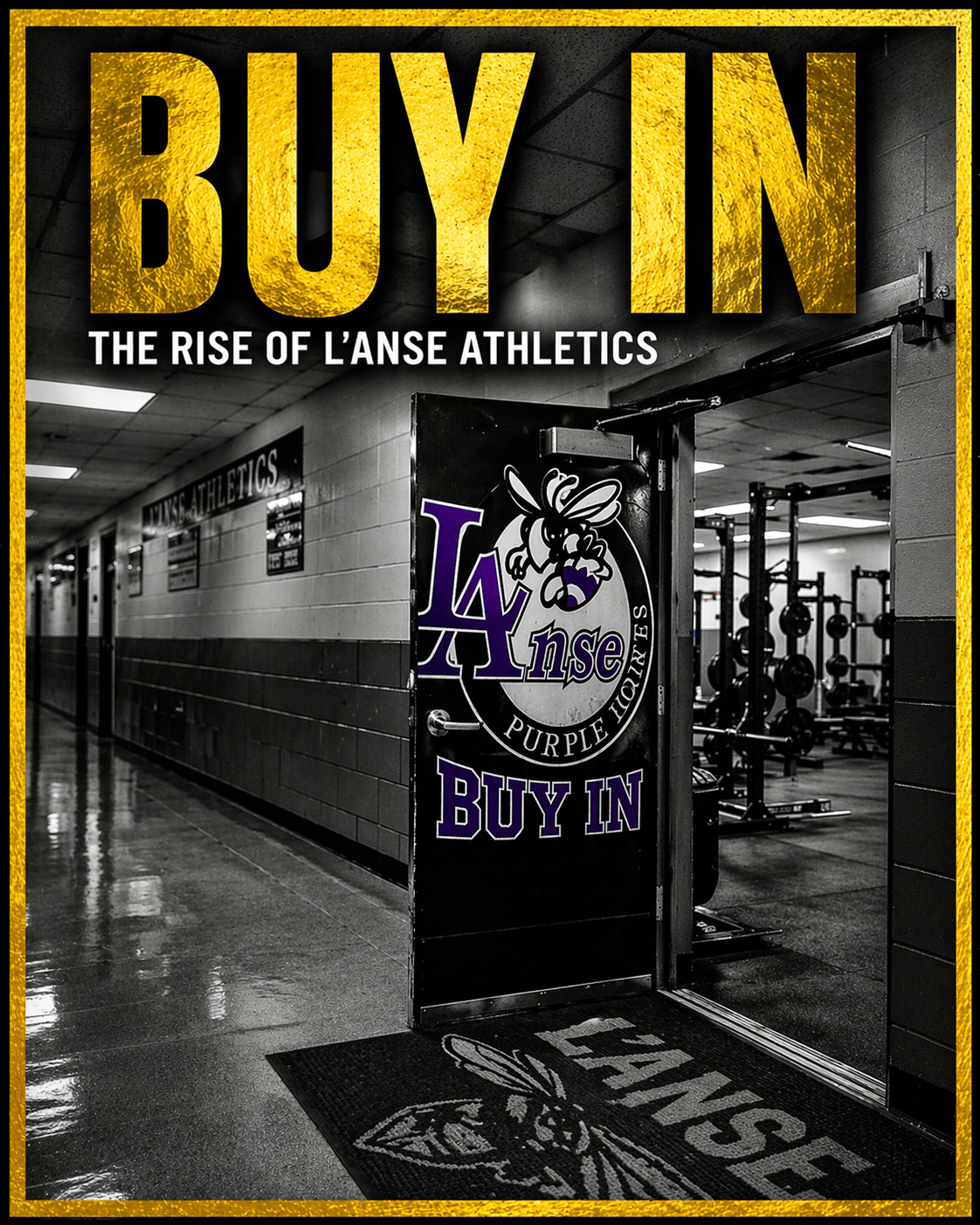
From doubt to discipline, L’Anse athletics found its identity and climbed back
September 27, 2019. L’Anse football improved to 4-1 with a 14-0 win over Lake Linden-Hubbell.
March 10, 2020. The L’Anse girls’ basketball team defeated Carney-Nadeau, 53-47, to advance to a regional championship game.
Two days later, on March 12, the sports world came to a complete stop.
“By the time things opened back up,” said Athletic Director Darrin Voskuhl, “we had completely lost our culture and pride in our school.”
All of a sudden, Voskuhl and other coaches found themselves walking the halls asking kids to play. Not to build a program. Just to field a team.
Commitment was at an all-time low. What looked so promising during the 2019-20 school year had started to slowly crumble.
The results showed it.
The football team lost its final five games in 2019, struggled through a 1-6 season in 2020, and by 2023, the program had collapsed entirely—forced to forfeit the season.
After that pandemic-shortened 20-4 run to a regional final, the Lady Hornets lost three of its next four district openers, each by double digits.
But this is not another “COVID ruined a small-town program” story. The pandemic may have been the main villain in a lot of high school plots, but in L’Anse, coaches and administrators made sure it barely made the opening credits.
Because somewhere along the way, something changed. Not overnight. Little by little, piece by piece, the Purple Hornets stung back.
If you had to pinpoint the catalyst of that turnaround, look no further than Sheila Royal—former varsity girls basketball now JV coach, current track and field coach, and the heartbeat of the school’s strength and conditioning program.
Ask around L’Anse, and her name keeps coming up.
“Coach Royal has been a huge benefit to the school,” varsity boys basketball coach Robert Potter said. “Coaching both basketball and track, she’s able to build relationships with students at a younger age than our varsity coaches. She really pushes kids to be the best they can be.”“Our program emphasizes strength and conditioning,” Royal said. “Over the past five years, I’ve added weightlifting, plyometrics, mobility work, and even yoga into our training—from junior high through high school.”
Royal was exactly what the school needed. Long before anyone talked about a culture shift, she was already building one. Investing in girls from junior high through high school, forming the kind of trust that makes students want to work.While Royal was shifting mindsets, not every program was winning yet.
Robert Potter stepped in to take over the varsity boys basketball program in 2023-24.
The early results could have pushed a slowly rebuilding program into panic mode. Potter finished 0-20, with 15 of those losses coming by 30 points or more.
We’ve seen this story before. Players blame the coach. Coaches blame the players. Athletic directors start wondering if they need a new direction.
But L’Anse wasn’t chasing a flashy, established coach—or immediate wins.
It was looking for something else.
“The number one thing I look for is commitment,” Voskuhl said. “Are they willing to put in the work and get athletes in the building? Secondly, can this person get buy-in from the kids? If both of those things happen, you’re already ahead of the game.”
The wins didn’t come right away. But the character did. And for a school that had lost its identity, that order mattered more.
“I’d say my coaching identity is built around the idea that my job is not to win games—it’s to teach these kids,” Potter said. “Teach them how to be better people first, and basketball players second.”Right on schedule with the vision, the character part showed itself, and the wins followed.
The payoff came quickly.
L’Anse won 10 games the next season, then finished this past winter at 15-7, including a stretch where they went 11-1 over a 12-game span.
Though the Hornets lost a heartbreaker to rival Baraga in the opening round of districts, optimism around the program has never felt higher heading into 2026-27.
“I think next year we have the opportunity to take another big step forward,” Potter said. “We should be competing for a conference championship. We should be playing for a district title, and we shouldn’t be satisfied with anything less than that.“But we also need to understand that we’re becoming a team; other programs circle on their schedule. We’re going to get the best version of everyone we face.”A laundry list of talent returns next season.
It starts with future senior center Quentin Supanich, a presence with size, length, and athleticism—someone capable of averaging a double-double.
Then there’s guard Sam Lee, already one of the U.P.’s most decorated players. Lee has earned Copper Mountain Conference Dream Team honors, All-U.P. First Team recognition, and Detroit Free Press All-State Honorable Mention. Sitting just shy of 1,000 career points halfway through high school, even the 2,000-point club could be within reach by the time he’s done.
But the most telling number might be his 3.9 GPA—the kind of standard L’Anse is trying to build.
And back to lead it is the soon-to-be junior guard Talan Larson, an All-U.P. Honorable Mention selection and team captain. Potter described Larson as an “old-school” point guard who wants to create for others—a description that conveniently mirrors the identity L’Anse is trying to build.
The girls’ program offers its own proof that the shift is real.
Since taking over in 2024-25, Josh Eagle has gone 38-10 in two seasons, guiding L’Anse to records of 18-6 and 20-4. But like the other coaches in the building, he talks less about records and more about standards.
Eagle remembers arriving at a previous stop and pointing to the wall.
“I had them look up at their banners,” he said. “I asked, ‘How do I know this isn’t a basketball school?’ You’ve got one banner up there. That tells me you’re not thinking big enough.”Five years ago, if those words were said to L'Anse, it might have landed differently on a program still searching for itself.
Now, they land on a group ready to answer them.
“The thing I’m really happy about is their knowledge of the game,” Eagle said. “If those girls sat down and had a conversation with you, you’d be pleasantly surprised by what they know.”
That growth shows up in the talent returning, too. Lana Connor, whom Eagle called the best shooter he’s ever coached, knocked down 40 percent from three. Quinn Voskuhl sees the floor so well Eagle believes coaching could be in her future someday, and the long, versatile standout can defend every position on the floor. Then there’s current sophomore Princess Pierre, who took herself out of a game just once all season—the kind of tireless, self-starting competitor who embodies what L’Anse is becoming.
None of that, Eagle would tell you, happens by accident.
“I’m a basketball junkie,” he said. “I can talk about it all day if you don’t stop me. I hate losing—not in the sense that winning is everything, but I hate not being successful.”
That mindset shows up in the hours. The gym is open 6 or 7 days a week. In the summer, Eagle is usually there every day. And wherever he’s been, he’s believed the same thing: a program does not have to stay what it’s always been.
When coaching at Hannahville, he got tired of hearing players talk like their ceiling was already set. So he challenged them. Stop saying you’re “just Hannahville.” Get in the gym. Work. Learn. Grow. Over time, they went from getting blown out to becoming competitive with good teams.
It’s the same kind of belief L’Anse needed. Not favoritism. Not shortcuts. Not empty speeches. Just a coach willing to pour everything he had into kids, no favorites, and ask for the same in return.
And now, the results are showing up in more than wins. They’re showing up in the way L’Anse’s athletes think, prepare, and carry themselves.
Here we are six years later. L’Anse football posted its first winning season since 2013. The girls’ basketball team reached a regional final. The boys’ basketball team went from zero wins just two years ago to 15. And this past fall, the cross country team won a U.P. championship.
They’ve gone from chasing kids in the hallways to building self-starters who are chasing championships. These haven’t just been athletes overcoming adversity, it’s been built into them to be bigger than their sport- future coaches, leaders, students of the game who go beyond surface-level questions
Pep assemblies are now K-12. Athletes spend time reading to younger students. Buy-in isn’t just an option anymore—it’s embedded in the school, carried by every young student who sees success, sees hard work, and no longer feels the need to ask permission to be part of it.Buy-in isn’t just part of the culture now. It is the culture.
